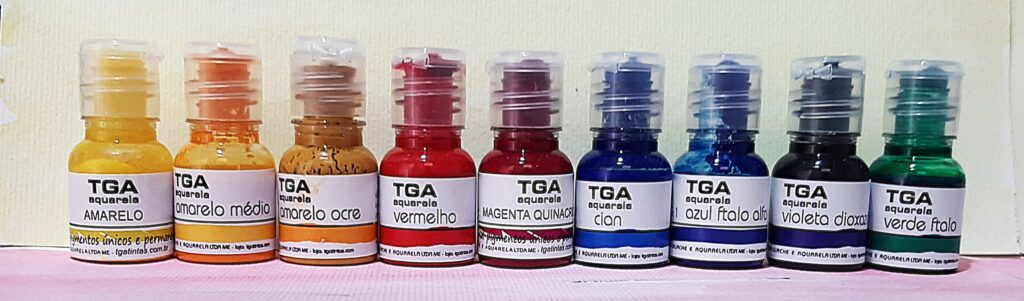
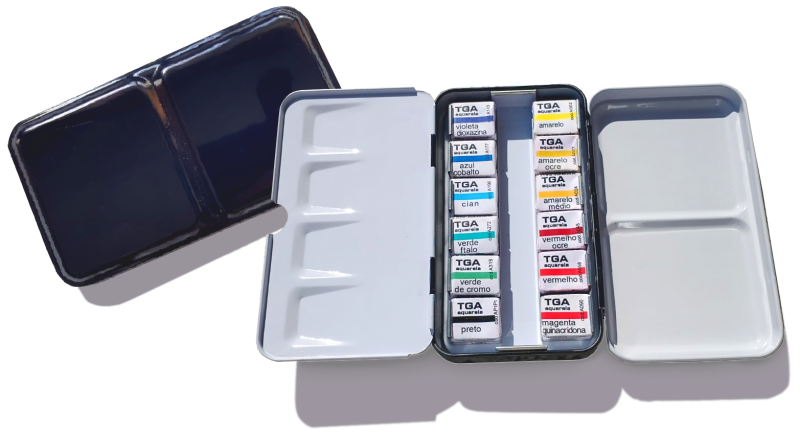
Watercolor paints bring the vibrancy of tones and the beauty of the transparency and layering of colors, available in pan and liquid formats.
The pans can be purchased in a pre-assembled set of 12 colors, packaged in a metal case that makes it easy to work in the field or even in the studio.
The colors in this set are: Yellow – Yellow Ochre – Medium Yellow – Red Ochre – Red – Quinacridone Magenta – Dioxazine Violet – Ultramarine Blue – Phthalo Blue – Phthalo Green – Chromium Green – Burnt Umber.
Liquid watercolors are supplied individually in the following colors: Yellow – Red – Magenta – Cyan – Violet – Green.
TRICHROMY. Use watercolors for your trichromy studies. It is a very convenient alternative. The colors are Yellow, Magenta, and Cyan.
ALL COLORS
Yellow Light | C.I. PY 53
Nikel Titanate pigment, a counterpart to Naples Yellow. Mix with greens to obtain more subdued Lemon Green colors
Yellow | C.I. PY 254
Benzidine. It is the natural choice for trichromy. It also corresponds to the Primary Yellow in the visually uniform color space.
Yellow Titanate |C.I. PY 24
Nikel and Antimony Titanate, similar to “Amarelinho.” When mixed with Red it produces more subdued oranges that are less dark compared to mixtures with Yellow Ochre.
Yellow Iron Oxide | P.Y. 42
Iron oxide. With high particle size, low transparency, and low saturation.
Medium Yellow P.Y. 110
Isoindolinone. Very saturated, high transparency, and strong tinting strength.
Oranje | P.O. 73
Pyrrole. Low saturation and transparency. Coarse particle size.
Red Ocre | P.O. 101
Iron Oxide. Low saturation and transparency. Coarse particle size.
Venetian Red
P.R. 101
Iron Oxide. Similar to Red Ochre, but darker and cooler.
Brown | P.R. 101
Iron Oxide. Low saturation and transparency. Coarse particle size.
Burnt Umber | P.R. 30
Iron, Chromium, and Nickel Oxide. A color with low saturation and transparency. High particle size (coarse granulation).
Red | P.R. 254
Color with high saturation and transparency. Low granulation.
Light Rose | P.V. 19
Quinacridone. A very light color with high saturation and transparency. Low granulation. It can replace magenta in mixtures with reds
quinacridone magenta
P.V. 122
Quinacridone. It is a unique color in the visually uniform system and is suitable for trichromy.
Permanet Rose | P.V. 19
Quinacridone. Darker than Light rose. High transparency and saturation. It has the same Color Index as Light Rose, but with a variation in the crystalline structure.
Dioxazine Violet
P.V. 19
Quinacridone. Color with high saturation, very transparent, and high tinting strength.
Useful for tinting and darkening other colors.
Ultramarine Blue
P.B. 29
With a color similar to Cobalt Blue, it is a substitute with easier application, greater brightness, and higher tinting strength.
Indanthrene Blue
P.B. 60
Anthraquinone. High tinting strength. A darker color, excellent for shadows and for modifying other colors.
Cobalt Blue | P.B. 28
Cobalt Aluminate. A traditional pigment used by artitists since earlier times. Similar to ultramarine, with lower tinting strength and coverage.
Phthalo Blue Alpha
P.B. 15:1
Phthalocyanine. With a more reddish undertone compared to cyan. A primary color in the visually uniform color space. Its application characteristics extend to other phthalocyanines.
Cyan | P.B. 15:3
Phtalocyanine. This pigment has very fine granulation, is highly transparent, and has high tinting strength, with a yellowish undertone. It is the recommended color for mixtures in the trichromatic system.
Phthalo Green
P.G. 7
Phthalocyanine. High saturation, transparent, and low granulation. It is also one of the primary colors.
Cobalt Green
P.G. 50
Titanato de Cobalto.Saturação media, granulometria alta e boa cobertura
Phthalo Green 36
P.G. 36
Phthalocyanine. High saturation, low granulation, and a more yellowish undertone than Phthalo Green 7.
Chrome Green |
P.G. 17
Chromium Oxide. Low saturation. Use for natural color, foliage, etc.